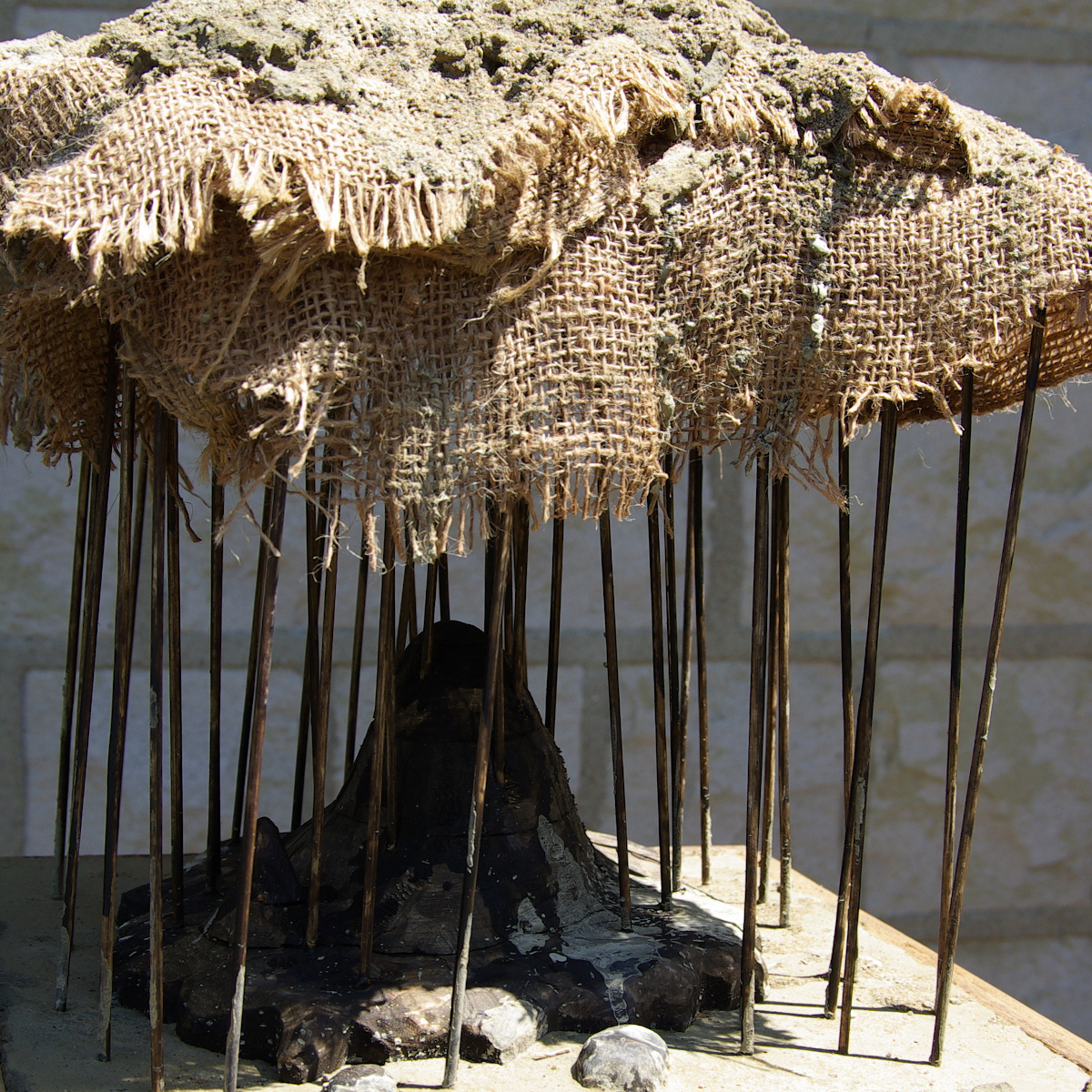
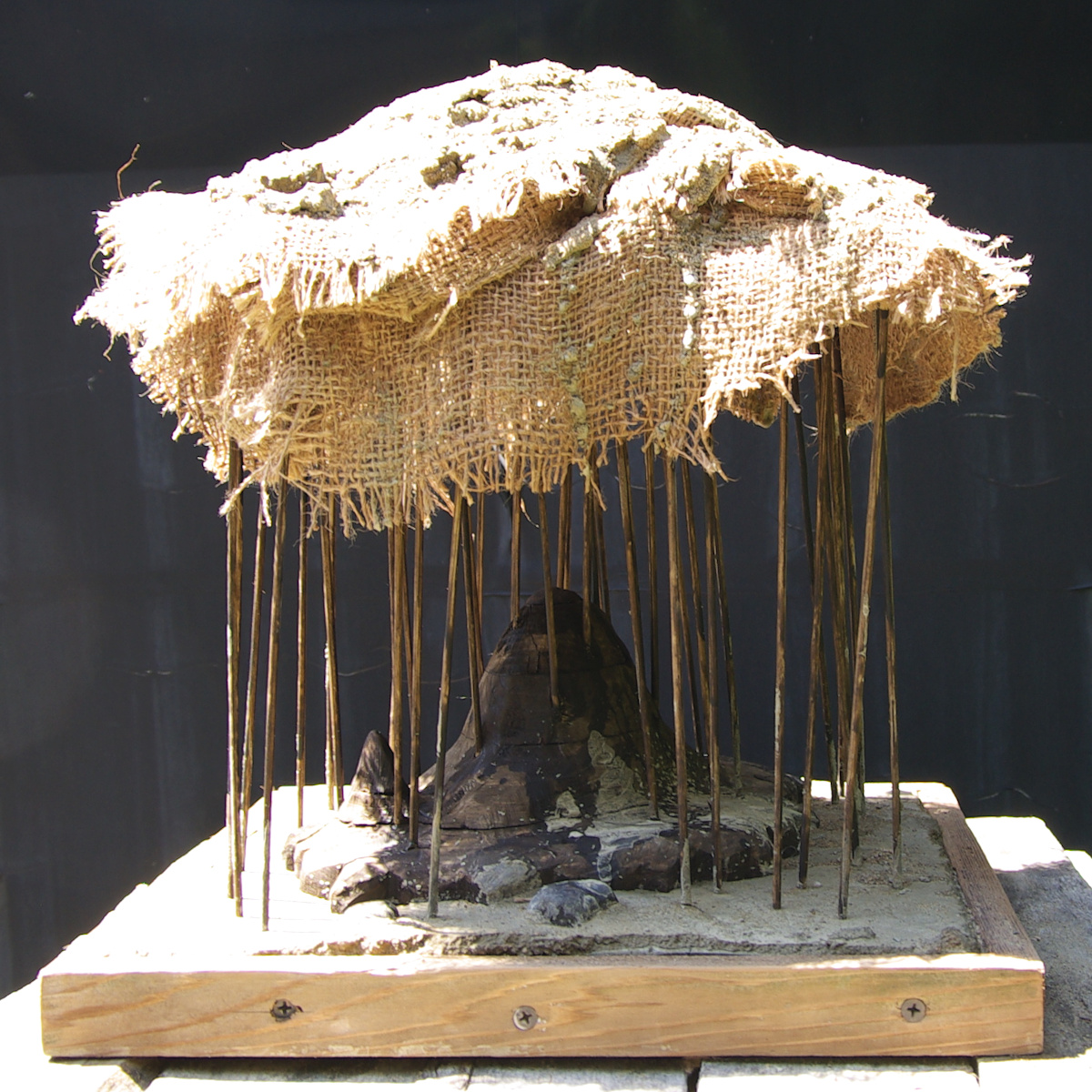
There’s an oil painting sitting on the easel in my studio, “Are there deserts in vector
space”. It’s four by four feet and I keep putting it on the back burner. Other priorities
come up, and there is a certain amount of logistical effort to set up to work on it. This weekend it
was a mix of playing catchup on some projects and fighting whatever current cold bug is running around.
But I really like the central idea behind the painting. Namely, where are our semantic blind spots?
What are the ideas that we don’t have language for? If we transformed language embeddings into a
map, into terrain, what would we see. So, I took some Windex to the magic mirror, and with the
assistance of Claude Code, started to find out.
The first thing, the most important thing, is that the tools we have available to us are powerful.
I have been coding since the Soviet Union was a going concern, but I would never have been able to
produce what I produced in the space of a few hours without these tools.
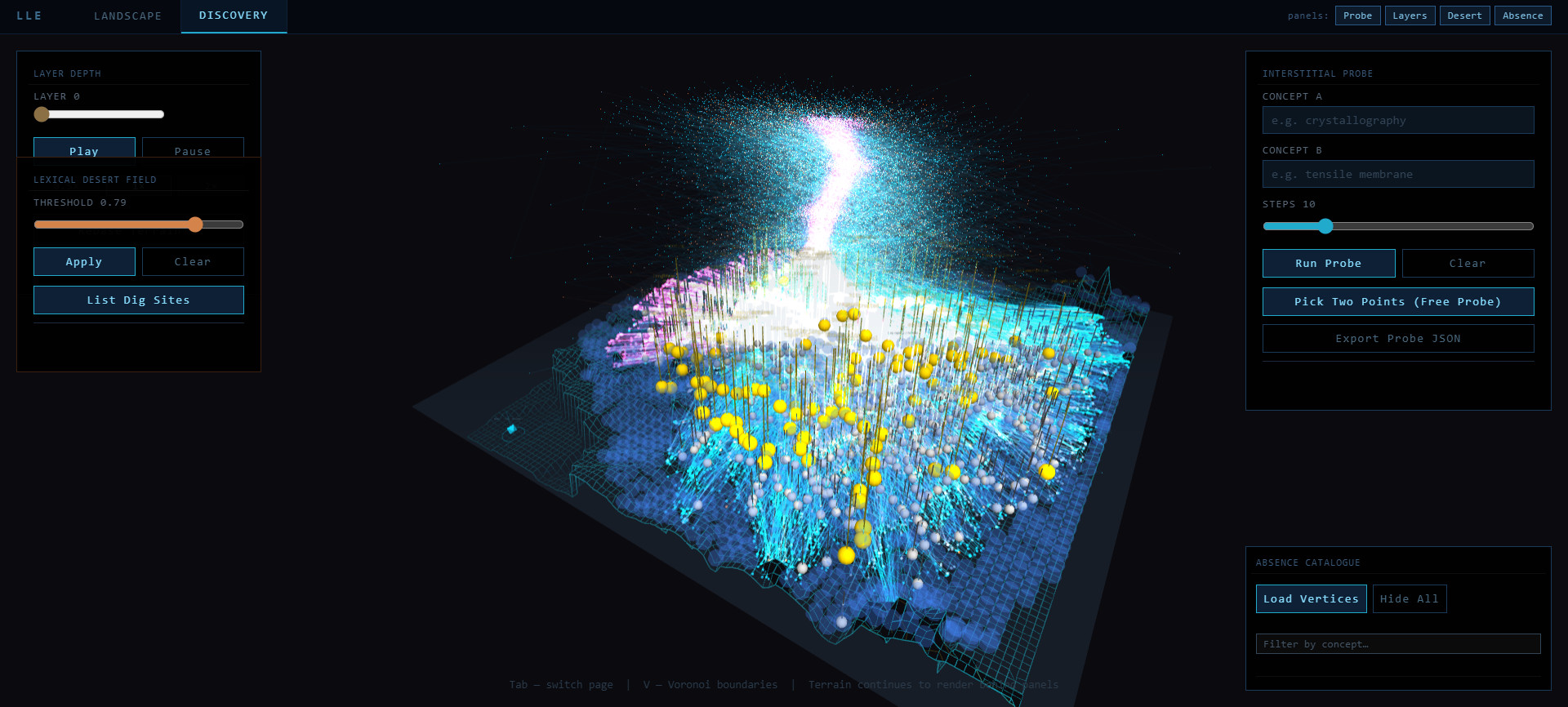
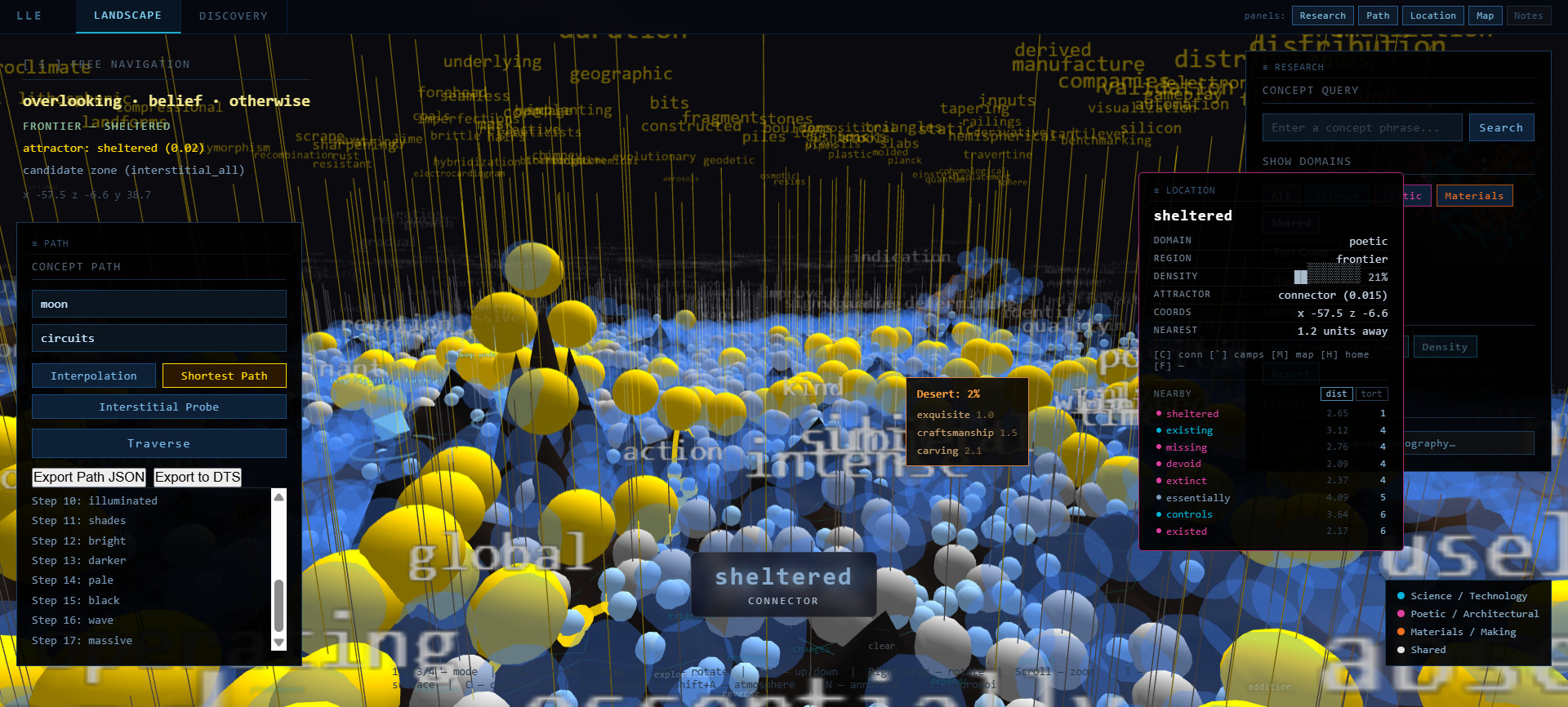
What the software is doing is looking at the connections between language. Specifically, it’s
finding semantic meanings that lack syntactic representation. Right now, I’m using specific
language from a bunch of different knowledge domains (Science, Art, Materials, etc.). The program
finds connections between them based on their embeddings (mathematical representations of their
meaning) and generates terrain. The height of the terrain indicates how densely meaning clusters in
that region. This produces valleys and saddle points connecting domains, ridgelines at the boundaries
of meanings that separate domains, and attractors which seem to generate a gravitational effect on the
words around them. It also produces deep valleys and deserts, where there is no language for the
concepts that sit there.
I had the magic mirror produce some project documentation, if anyone is interested in the clockwork in the background. As a note, working with this particular magic mirror, on this particular project, the documents are aimed at me: I am the audience of my own work. They make recommendations, and assumptions about my own art, based on what it knows, some of which are incorrect, which is fine. I may polish up those spots. Or not.
So, one of the issues I face is: is it worth it to pursue and perfect this particular fever dream?
It’s neat. It produced some neat things. Made me see the world a bit different. Made me learn
some tricks. Should I leave it there or is this a project I should pick up and put on the workbench
with the others. It ain’t like there’s nothing up there already. I know that there’s
more I could do with it as it is, but I might just be overworking the painting. Probably the best bet,
if I were to carry on would be to take the lessons learned and start over with a fresh canvas and some
clean brushes.
If I did pursue it, what would I do? D’abord, the project lacks rigour. It draws a map of
latent space and lets me look into the spaces in between landmarks. But. But the map is a hand drawn
scrawl on the back of a dirty napkin with “Here there be monsters (maybe)” in ball point
pen. Which is fine for what it is, but, if I rebuild it, version 2 will be based on a taxonomy more
complex than whatever bits I could pull out of an old shoebox. In retrospect, with all the book
learnin’ on the nature and management of information that I have, it’s honestly a little
embarrassing. I blame the head cold. So, number one with a bullet: taxonomy.
Second, coherence. This thing was built around an idea, and then more ideas have been duct taped onto
it. It is an apple crate go cart built with four different wheels, no brakes, and flames drawn on the
front with magic marker. But I think I know now what it should look like, or rather, what it should
do, so the initial minimum viable product will be a little better off. Going into this with a coherent
strategy would give me something a lot more clean, and a lot less MacGyverey.
Finally, collaboration. Sometimes expeditions into the uncharted wilderness are best undertaken with
others. Who, you know, know stuff. And carry extra gorp. At the very least, if I go any further with
this, I will reach out to some folks for advice about where the quicksand is. See if anybody has any
rumours about where one might find Atlantis or El Dorado or the nearest Circle-K. Which is another
pitfall of this project as it stands — or a success, maybe. I just went out looking to see if I
could find something in the empty spaces on the map. And yup, all it takes is a couple of steps and
there’s stuff there. But looking for something specific, that’s something else.
About the Latent Language Explorer V2 tool →